Eggshells have been used in gardens for many years. We are not the only ones figuring out how to use them to make the soil less acidic or as an organic fertilizer. Still, eggshells can be seen as more important than they really are in gardening, and there are some key points you need to understand to use them well.
Our classes are designed for new gardeners «Modern garden». In these classes, you will discover how to grow lots of food naturally. If you care about the environment and want useful tips, these classes are perfect for you. They are online, so you can begin right away.
Benefits of eggshells being told:
- Eggshells are useful as fertilizer;
- Eggshells alkalize the soil;
- It can be used as a natural nursery for seeds;
- The sharp shells of the ladles repel snails;
Eggs are often used for the above reasons, but not always correctly. Very soon we will examine what properties eggs really have and when it is not appropriate to use them.
What materials do eggshells contain?
 simple laws that always work
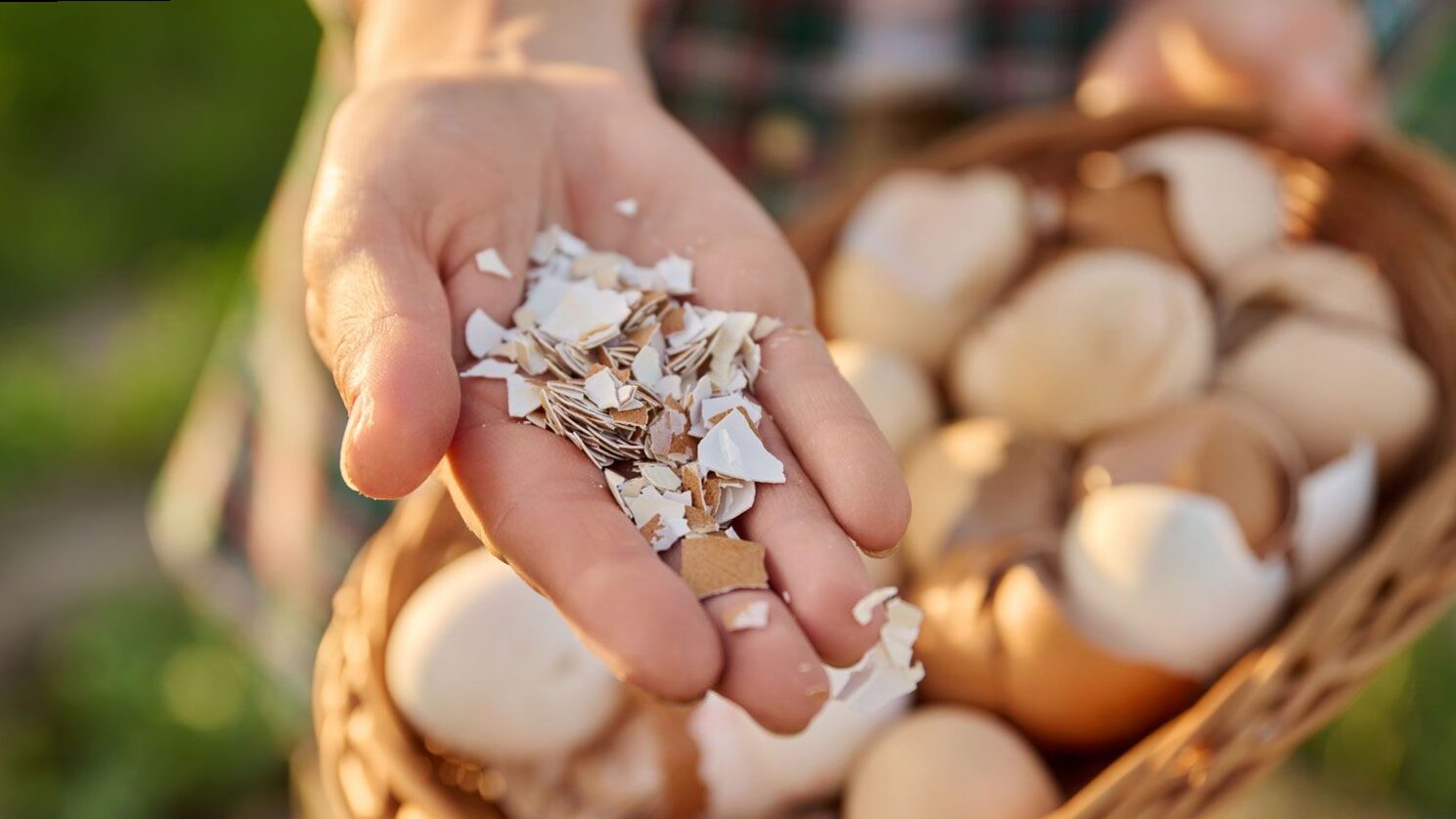
Calcium is the main reason why the benefits of eggshells have long been known in gardening. As you know, this mineral is necessary for all living organisms, including plants, and eggshells contain a lot of it. Up to 34% of the egg shell is made up of calcium.
Interestingly, organic materials can also be found in shells, which are rarely mentioned in literary sources. Organic matter makes up about 5% of the eggshell and accumulates in the white film that covers the inside.
Eggshells also contain some phosphorus, potassium, magnesium and sodium. However, these materials are so few that it is not even possible to start a conversation about them. Not very much. Almost nothing. Point.
And football is definitely worth talking about.
Read more Planting flowers in a bed – video instructions!
Egg shells in the garden as a source of calcium
Eggshells are one of the strongest objects known in nature. No wonder: their main function is to protect the contents of the egg. Archaeologists are still unearthing perfectly preserved remains of eggs dating back thousands or even millions of years. For example, very recently in China an egg at least 66 million years old was discovered with a perfectly preserved dinosaur embryo inside (more information on the discovery Here). Why then do we think that eggshells in the garden decompose quickly and give plants all the substances they contain?
Scientists in the United States have conducted research, I will try to explain the essence of it in a simple way. After adding eggshells to the soil, the amount of calcium in the soil should change, that is, calcium should increase.
Hand-crushed eggshells have not been found to alter calcium levels in the soil. It takes a long time for the peels to break down into particles small enough for the calcium in them to reach the plant.
The good news is that eggshells can transfer all their goodness to the soil, but one condition must be met: they must be ground very finely. The finer the shells, the more likely the soil is to absorb calcium and be able to pass it on to plants.
Read more Transplanting peppers is a careful method without damaging the roots
Bottom line: Eggshells can be used as a source of calcium, but they must be ground.
Egg shells to alkalize acidic garden soil
Eggshells are believed to alkalize the soil. There is some truth here: Research has shown that eggshells can alkalize soil if the following two conditions are met:
- Eggshells need to be ground,
- The soil must be acidic.
Calcium carbonate dissolves in acid and this reaction does not occur in an alkaline medium. Therefore, ground eggshells in acidic soil release calcium to plants and change the pH of the soil. And they won’t make alkaline soil even more alkaline.
Egg shells in the compost
So what about compost? Why does the eggshell decompose inside it, although the compost soil is not acidic? Few people destroy eggshells before throwing them into the compost bin.
Read more how a Soviet building turned into a cozy courtyard
In the course of composting, all organic matter goes through certain stages, and in one of them an acidic medium is created. That’s why eggshells decompose quite well in the compost bin.
Composting breaks down the inner film of the peel with organic matter first, followed by the outer part of the peel.
Egg shells – as fertilizer for tomatoes
How about using eggshells to grow tomatoes? In the summer, once the tomato fruits have developed, check their tips: if they begin to turn black, it indicates that the plant does not have enough calcium.
To avoid this, a regular gardener puts eggshells in the hole when planting seedlings. You can also use bone meal or fish meal. Keep in mind: flour. Therefore, if you are choosing eggshells, make sure to grind them into a flour-like texture.
Once you notice a calcium deficiency, eggshells won’t be effective. Tomatoes may lack calcium even if there is plenty in the soil. They might not take in calcium under challenging growing conditions, like when temperatures in the greenhouse are too high. So, if your tomatoes start to show calcium deficiency, it doesn’t necessarily mean you’ve added insufficient eggshells to the soil; there could be other causes.
In this situation, it is advisable to spray fertilizers containing calcium so that the plant can take it in through the leaves. It is best to do this at night when the temperatures are cooler.
You can find more details about growing tomatoes here.
Shells are like nurseries
You’ve probably seen on social networks that in early spring you can make organic nurseries with eggshells: you just need to put a little soil in the shell and plant a seed.
But the truth is that it is a game at best: the eggshell is simply too small to fully perform the function of a pot. The roots will quickly run out of space, so the seedling will still need to be transplanted into a larger container later.
Others say that the sprouted plant can subsequently be transplanted directly into the ground with the entire shell, and it will nourish it with calcium and other necessary substances as it decomposes. Don’t be fooled: it definitely won’t happen like that. I already mentioned that whole eggshells decompose very slowly. Meanwhile, the seedling grows rapidly, and if its roots always rest on the eggshell, the growth will definitely not be of high quality.
Egg shells from snails
Another common myth is that eggshells help protect against snails. It is said that snails don’t like to crawl through eggshells because they are too sharp.
If you’ve ever tried this trick in your garden, you probably already know that these «balls» are really not afraid of eggshells. Snails secrete mucus to help them crawl through sharp particles, so no amount of shelling will stop them.
Information about eggshells in brief:
- Eggshells are not a panacea as they decompose slowly and do not contain all the necessary minerals and vitamins.
- We can transfer calcium from the peels to the plants if we meet the necessary conditions: We grind the peels as finely as possible.
- If your soil is acidic, finely ground eggshells can change its pH and make it slightly alkaline.
- Eggshells are not suitable as a nursery – they look beautiful and organic, but the seedlings will still need to be transplanted into larger pots later.
- Eggshells do not act as a slug repellent.
- Eggshells are suitable for composting.
latest posts published

how to recognize the problem and how to save your lawn
Growing Peas for Beginners: Here’s What You Need to Know
3 ways to clean the gaps between pebbles – without chemicals!
Collecting sprouts: the most common mistakes
my review on the greenhouse harvest –
Which plants and how to cover the garden at the end of winter?

Take care of the graves in autumn, so that they are beautiful even in spring
what you will find in Lithuania if you decide to try it
English style: how to create one in Lithuania