How to water plants when summer does not spare the heat, and it has to rain much more often? In this video I shared some tricks that will make watering more efficient: you will save time and water:
If it is more convenient to read, in the article you will find information on watering lawns, flower beds, fruit trees, fruit bushes, greenhouse vegetables and potted plants.
Water from above or directly to the roots
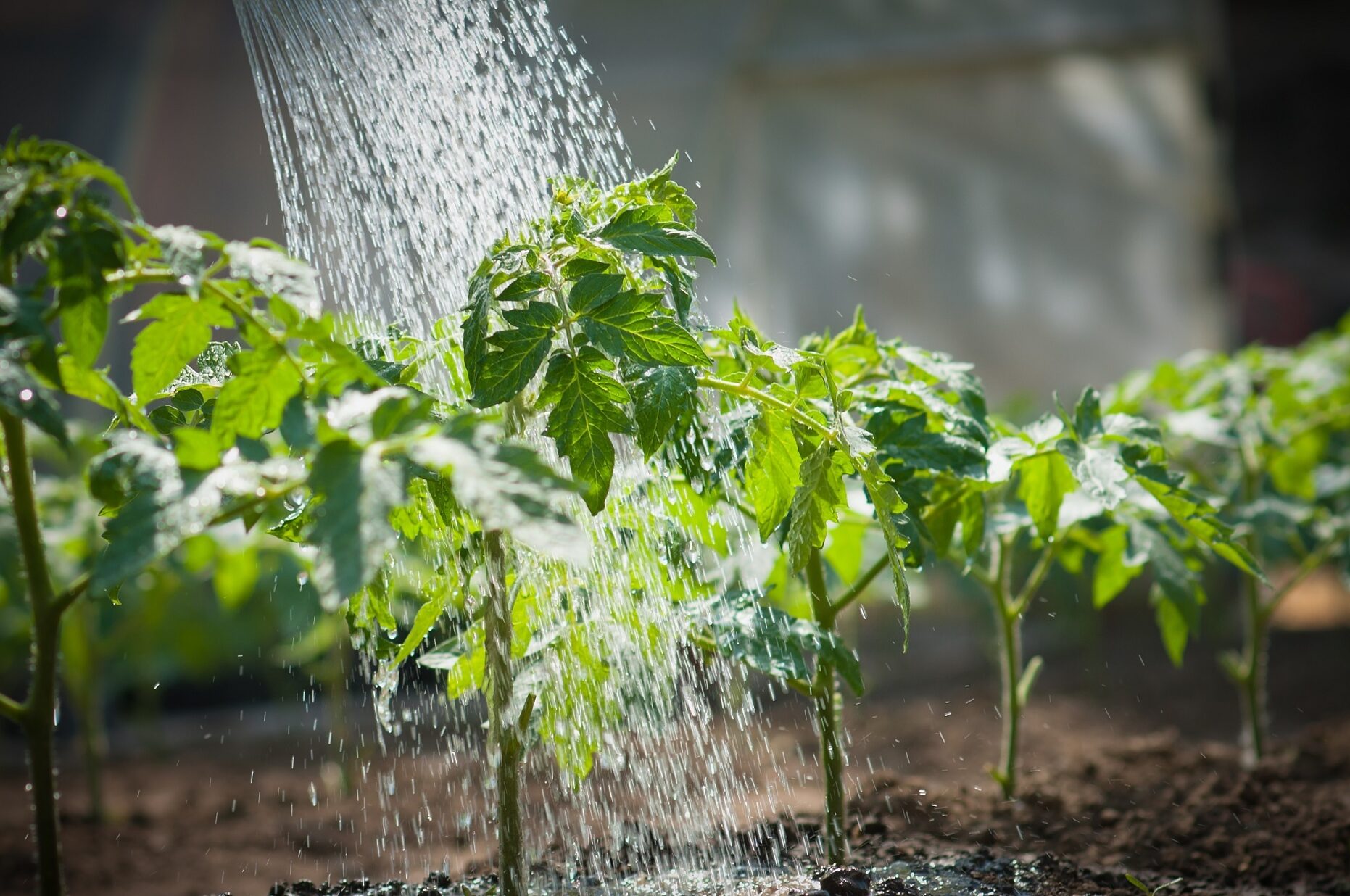
Does it make a big difference how you water your plants? Yes, there is.
Read more beauty and taste in a single bridge / Geltonas Karutis
We water the lawn only from above, because the roots of the lawn are superficial and only in this way can we irrigate large areas of the lawn.
Other plants prefer to be watered from below – not all of them like to be sprayed with water. Strawberries, green beans and tomatoes don’t particularly like water on their leaves: excess humidity can be disastrous for plants prone to fungal diseases. For such plants I recommend installing a drip irrigation system, which will help supply water to the plants through the roots. You will save water because:
- You will water exactly where you need it: you will not waste water in the areas between plants;
- Water drips from the tip of the stem – it is fed directly to the roots, not onto the soil surface. Therefore, less water evaporates through the soil surface;
- The amount of water supplied can be easily controlled and distributed equally to all plants.
Hot or cold water
Undoubtedly, warm water is a much better choice for plants than cold water. But it often happens that the water for irrigation comes from a well or a water pipe: what to do then?
- Colder water is also perfect for watering the lawn, as it should be watered in small, scattered drops;
- The same goes for drip irrigation systems: by dripping little by little, the water has time to warm up a little;
- If you water the plants with a watering hose, it also manages to warm up here before reaching a certain plant: many plants are tolerant and certainly will not be afraid of cooler water;
- I only pay attention to heat-loving vegetables, like tomatoes or basil. These veggies definitely won’t thank you if you drink them in ice water.
The easiest way is to fill buckets or watering cans with cold water and let them sit. After a few hours, the water will have stabilized, warmed up, perfectly ready for irrigation. Except that the view in the garden won’t be beautiful – those buckets with water, well, you understand…
Read more how to plan your work wisely | First step: overview of available plants
A more convenient way is to purchase a 200-liter water tank. Fill it with tap water or collect rainwater from roofs. Open the tap: hot water flows. Very convenient.
The next step is to place such a container near the greenhouse, raised at least 1 meter. Such a lift is enough to install a simple drip irrigation system for your greenhouse vegetables without electricity. Open the tap and your vegetables are already watered.
Short and hard or slow and little by little
Imagine a very short downpour: torrent, even rivers flowing through the gardens. After the rain stops, you can do an experiment and dig the soil with a shovel. There is a high probability that the results will not satisfy you: only the surface of the soil will be moistened, and everything else will be like goose water. This could have happened for several reasons:
- The water of a powerful but short rain did not have time to penetrate into the deep layers of the soil and simply flowed to the surface;
- If the leaves of the plants are large, they create an umbrella effect: the water simply flows through them, but the roots remain unwatered.
Here’s the answer: Watering briefly and intensely doesn’t guarantee that your plants are getting enough water.
Read more Tim Richardson: Garden designers will cure global warming
Prolonged and abundant watering is even more dangerous for plants, because then a puddle forms, the roots do not get air, they begin to rot and the plant can die.
How it should be watered:
- I always advise fruit trees and shrubs to create such a «plate» of soil around the trunk: excess water will not drip from the soil surface, but will gradually flow towards the roots (especially relevant for those growing on a slope);
- Water drought-affected plants carefully: Cover the surface of the soil with a light mist of water and let it soak for a few minutes. And then water slowly and for a long time – to reach and moisten the deep layers of the soil. This is exactly what I do with my perennial flower garden: I don’t usually water it, but I have to during the dry season. Therefore, I choose the smallest scattered stream and water for a long time. The same goes for pots if you grow the plants in a peat substrate. Peat dries, hardens and shrinks, so first it is necessary to moisten the entire surface, and only then start watering gradually;
- The «slow and long» rule also applies to lawn watering. It is advisable to water the lawn not a little every day, but 2-3 times a week, in a prolonged, slow and abundant way.
When to water plants
The timing of watering is also very important.
- It is best to water plants early in the morning, after sunrise. Plants are able to absorb moisture, but do not have time to evaporate it before the onset of heat;
- If you can’t water in the morning, you can do it in the evening. It is important not to overwater the plants. Excess humidity can create an excellent environment for the spread of fungal diseases and various slugs;
- Watering on a hot sunny day is the worst choice. A drop of water on the plant becomes like a magnifying glass, and when the sun shines, it can burn the leaf (a dry brown spot is visible).
But if there is a dilemma: to water during the day or not to water at all, the answer is simple: to water during the day.
Read more How to make branches bloom and which branches are suitable for this
Water the pots
If you want to create conditions for less frequent watering of pots, I have some tips for you:
- The larger the pot and the more soil it contains, the slower the moisture evaporates, so you will have to water it less often. Therefore, a large pot with many plants is better than many pots for one plant;
- Choose the right substrate. For example, peat dries very quickly and it is quite difficult to saturate it with moisture. Therefore I recommend choosing a mixture of compost and expanded clay. Such a mixture retains moisture much better;
- Improve the substrate with various moisture-retaining additives such as vermiculite or absorbent pellets. I have prepared a separate article about vermiculite and its benefits, you can read it here
Mulching
Mulching your plants is another way to help you use your garden hose less frequently. Evenly spread mulch keeps the moisture level just right in the soil. There are many ways to mulch, from pine bark mulch, to simple straw, to more unique choices like buckwheat mulch ( I discussed it here). Keep in mind that mulched soil not only requires less watering but also needs less weeding – in short, one of the benefits.
And lastly, I want to remind you that the key everywhere is moderation, so do not water too much. If you water often and in small amounts, you will damage the plants: they will stop growing deeper roots. Watering less often but in larger amounts will encourage plants to grow deeper roots and become more resistant to dry conditions.
latest posts published

how to recognize the problem and how to save your lawn
Growing Peas for Beginners: Here’s What You Need to Know
3 ways to clean the gaps between pebbles – without chemicals!
Collecting sprouts: the most common mistakes
my review on the greenhouse harvest –
Which plants and how to cover the garden at the end of winter?

Take care of the graves in autumn, so that they are beautiful even in spring

what you will find in Lithuania if you decide to try it
English style: how to create one in Lithuania