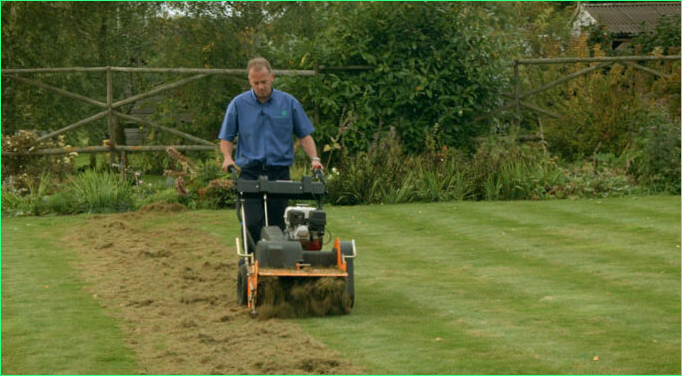
Scarification, combing, lawn aeration: do you know what it is? Very often these terms are confused or assumed to be different titles for the same job. So, this time I will try to untangle this knot and give a simple answer to what lawn scarification is, why it is necessary, how and when it should be done and how it differs from aeration:
Below I have listed everything simply and clearly:
- What is scarification and why is it necessary;
- How to scarify: 1) young grass, 2) normal mature lawn, 3) large surfaces or when the turf is very dense;
- What should the field conditions be;
- When to fertilize after scarification;
- What is the difference between aeration and scarification and when is it really necessary.
WHAT IS LAWN SCARIFICATION AND WHY DO YOU NEED IT?
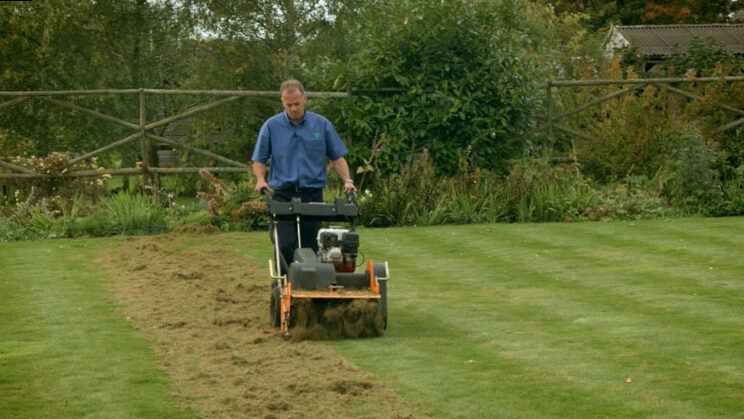
A lawn growing in good conditions is consistently thicker, but over time it becomes so thick that the tangle of roots turns into thick thatch. It becomes difficult for the roots to get enough air and water, it is not possible to absorb quality nutrients. Then scarification is necessary (about aeration – in the article below).
Read more how famous is this landscape architect
Scarification is usually carried out in spring. During it:
- Last year’s dry grass is combed;
- The soil surface is scarified to a depth of 1-3 cm.
nnsnow moldangry or otherwise tired. After scarification, air, water and fertilizers reach the roots of the lawn more easily, so the lawn recovers, strengthens and grows more quickly.
There are several ways to scarify your lawn. I have distinguished three levels to make it easier to decide which one is right for you.
METHOD 1: DISCHARGE OF YOUNG LAWN
The first method is used for young, first or second season lawns, where thinning is visible after winter. If there is no thick felt, there is nothing to cut.
Just get a simple one leaf rake and easily brush the lawn with it. This will remove the remains of dry grass, slightly “tickle” the surface of the soil and thus prepare the lawn for the new season.
Read more How to sow vegetables in pots: simple instructions
METHOD 2: SCARIFICATION OF A MATURED COMMON LAWN
When your lawn has been growing in the yard for more than a year, it is necessary not only to comb it well in the spring, removing the remnants of last year’s grass, but also to make cuts in the dense turf.
If the lawn surfaces are not large, a scarifying rake is very suitable for this purpose.
nntip of the scarification rake.
I won’t hide it, you will have to work with a rake, but this process is very useful for the lawn, and it is not excluded that we move more intensively outdoors, right?
METHOD 3: WHEN THE GRASS IS VERY DENSE AND THE LAWN OCCUPIES A LARGE AREA
The most severe scarification is needed when the grass reaches a depth of 2-3 cm: less than this depth it is especially hard for the roots to get air.
Read more The new gardening term “Healthy design”: what to expect at the Garden Style 2024 conference
Such a deep layer forms when the lawnmower or lawn robot does not pick up the cut grass but puts it back on the lawn. This way, the lawn is naturally mulched, becoming denser and prettier. However, the turf also gets packed much quicker, so more effort is needed in spring.
If your lawn is large and the thatch layer is very thick, scarifying with a rake may be too challenging physically. So, it is a good idea to consider a special electric scarifier.
WHEN TO DUMP THE LAWN
Lawn scarification is done in spring, but there is no need to rush. Do this job when:
- Outside there will be at least +10 °C, because if it is cooler the lawn will be more stressed;
- The prerequisite is that the lawn is completely dry. If the grass is wet, you will only stretch it, doing more harm than good.
In other words, when you see that it’s a warm, sunny, dry day outside the window, grab a rake or scarifier, go out and tidy up the lawn.
Read more What do you need to know to grow healthy rhododendrons? / Yellow wheelbarrow
FERTILIZATION AFTER UNLOADING: EXACTLY WHEN TO DO IT
After scarification, the lawn should be fertilized with complex spring fertilizers. Which are the best to choose, you can read here. When to do it:
- When companies carry out scarification, they usually spread the fertilizer right away so they don’t have to go back again. However, if you do this work yourself, we recommend waiting a couple of weeks for the lawn to recover and fertilize.
- Fertilize before expected rain or water generously after fertilizing. Water is essential for the lawn to absorb fertilizer.
- Fertilize when the average daily external temperature is at least +8 °C. This is also necessary for the assimilation of fertilizers: do not sprinkle them in vain.
HOW AERATION IS DIFFERENT FROM DISCHARGE AND WHEN IT IS NECESSARY
During scarification the soil surface is scarified to a depth of only 1-3 cm. Meanwhile, during aeration, the soil is not cut, but stabbed, even drilled to a depth of 5-10 cm. The goal is to get air into the deeper layers of the soil.
Aeration is not necessary for all lawns, but it is helpful if the soil:
- Clayey, non-conductive and heavy: in such soil the roots of the lawn cannot breathe well, they suffocate, so it is necessary to let the air in as deeply as possible;
- Heavily crowded and very hard: This can happen when the lawn is walked on very hard, there is a lot of running, football is played, etc.
latest posts published

how to recognize the problem and how to save your lawn
Growing Peas for Beginners: Here’s What You Need to Know
3 ways to clean the gaps between pebbles – without chemicals!
Collecting sprouts: the most common mistakes

my review on the greenhouse harvest –
Which plants and how to cover the garden at the end of winter?

Take care of the graves in autumn, so that they are beautiful even in spring

what you will find in Lithuania if you decide to try it

English style: how to create one in Lithuania