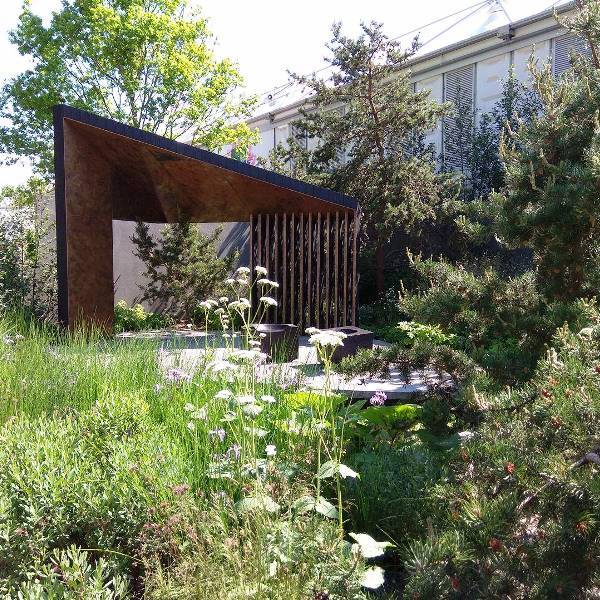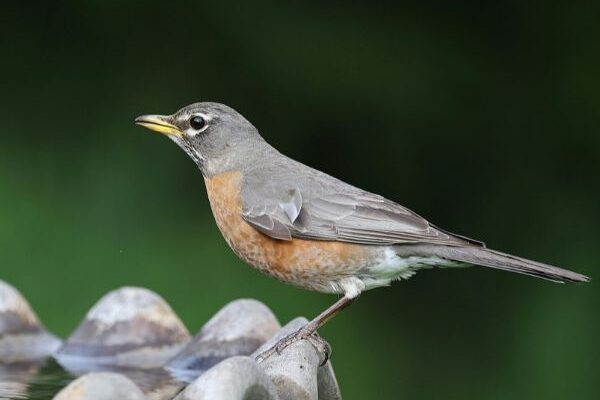
Internationally, the term «soundscape» seems increasingly popular. The voices of birds, the chirping, the rustling affect us more than we think. Želdynai designer, professor at the Lithuanian Faculty of Engineering Rasa Povilionienė shares practical tips on how to enrich your garden landscape design with sound.
We also heard Rasa’s message At the «Garden Style» conference. in Vilnius. On August 23, the specialist shared the amazing report “Soundscape: How garden sounds can become the basis of design.”
The landscape designer’s path

I was probably interested in landscaping long before I realized it could be a career path. I grew up in the Dzūkija region, surrounded by beautiful forests, lakes and meadows. Since I was a child, I spent a lot of time in nature: we picked mushrooms, picked berries and medicinal herbs, I knew where lingonberries ripened, where and when sedges, boletus or sedges sprouted, St. John’s wort or sandworts bloomed. I hung out with a group of foresters, we planted trees and learned to identify plants. The connection with the landscape was formed naturally.
Read more The tastiest tomato varieties of 2019: my greenhouse harvest
That’s why after school I chose a different path: I graduated in transport engineering and worked in the passenger transport sector. Everything changed after maternity and parental leave. I felt I would never do the same job again. The man, seeing me tinkering in the garden until dark after going to the village, suggested: «How about landscape design?» At first the idea seemed utopian: flipping through magazines with impressive examples of landscape projects, it seemed distant and unattainable.
I started studying landscape architecture 14 years ago. However, after finding out » Yellow “wheelbarrow” courses.I clearly felt that it is extremely interesting for me and I want much more. From that moment, 12 years ago, my true passion for landscape design and ecology began, which completely absorbed me and continues to this day. I already knew many plants, so I had to learn the principles of composition, technical and legal nuances. And the most important thing: as you learn in the «Yellow Wheelbarrow», everything finally «falls into place» so clearly, which I had never experienced in previous landscape studies.
What project excites you the most? What makes it special?
The project that is still particularly dear to me is Nemunas 7. It is an old dredger that has been resurrected as a cultural and environmental platform on the water. I had the great honor of being part of this project and realizing the vision of greenery according to the concept of «pioneer plants» proposed by designer Ula Marija Bujauskaitė.
Read more A beautiful plot in winter: practical advice on how to make it.
For this project, I had to find ways in which plants could not only grow, but also convey a message about adaptation, climate change and recovery processes. It was a step out of my comfort zone, but also a very inspiring experience: I knew that this work spoke not only about beauty, but also about our relationship with the environment, nature and the future.
If you are interested in «Nemunos 7», click This the connectionyou can watch the LRT program «Čia mano sodas», where this project is immortalized.
What criteria do you follow when creating a project?
For me it is important to create not only a beautiful, but also a living and changing space that strengthens its ecological value over the years, instead of weakening it. In other words, I consider the landscape not as a decoration, but as a living system of which man is one of the parts.
Each project is like a negotiation between human desires and the logic of nature. When all this can be coordinated, a real connection with place appears and greenery becomes a living, breathing space that provides ecosystem services: it helps retain water, improves soil structure, reduces noise, creates habitats for insects and birds and improves the microclimate.
Read more Tomatoes that do not need pruning: all about them
«Soundscape» – soundscape
Few of us have heard the term “soundscape” before. What does this definition mean?
«Soundscape» in Lithuanian is a soundscape, or an ambient soundscape. It is the set of sounds, natural and man-made, that are heard in a given place.
This term was first used in the 20th century. in between, and widely popularized by Canadian composer and acoustic ecology pioneer Raymond Murray Schafer. He encouraged considering the sound environment not as a background, but as an active spatial experience that influences human well-being, place identity, and even ecological condition.
RM Schafer is famous for distinguishing between different types of sound:
Read more Greenhouse in spring or how to prepare a greenhouse after winter
- geophony – natural sounds of inanimate nature (wind, rain, rustling leaves),
- biophony: sounds of living organisms (voices of birds, insects, animals),
- anthropophony: sounds caused by human activity (transport, technology).
In your message “Garden style” at the conference you explained to me how to enrich the garden with sounds. Why is sound in the landscape important to you?
For me, sound is an invisible but very sensitive dimension of the landscape that we often underestimate. Having grown up in the nature of Dzūkija, I heard about it from a young age tongue the environment: the rustle of the wind in the trees, the singing of birds, the abundance of insects in the June meadows, the babbling of the stream. The sounds created the spirit of the place, a personal sense of security, which undoubtedly contributed to the formation of the corresponding values.
Sound in the landscape is not just what we hear, but also what we hear when we are in a certain place. It shapes our relationship with the environment.
Noise pollution is an ecological problem no less important than air or water pollution, so we must take care of the acoustic environment in the same way we take care of clean water or air. This is exactly what I will invite you to do in my report: look at the soundscape as an integral part of the landscape, worth not only listening to, but sometimes protecting and sometimes consciously and responsibly creating.
Practical advice
What are the simplest ways we could enrich our garden with sounds?
The most important thing is to let yourself be listened to. Sometimes there is no shortage of sounds in the courtyard: silence and time to stop are enough. Well, the simplest tips:
- Plants that make sounds:
Tall ornamental grasses such as miscanthus, sedges and millet sway beautifully in the wind.
Trees that «speak», e.g. birches, aspens, their leaves tremble even with the slightest wind.
Plants that attract animals – nectar producing plants such as limes, brambles, elderberries, catnip, honeysuckle, honeysuckle, which will attract bees, bumblebees, birds – and will brighten up the yard in their own right.
- Encourage the birds to settle
Prepare nest boxes and feeders: Even a simple feeder in the winter or a song thrush in the spring changes the entire soundscape.
Avoid pesticides: A healthy insect world will ensure more birds, which will create more biophonic sounds in your garden.
- Add a fountain
Even a small fountain or stream can provide a soothing background sound.
- Let some of nature grow naturally
A patch of lawn with native herbaceous plants will not only attract insects, but will also provide a lively background sound: bees, grasshoppers, cicadas, even the movement of leaves in the wind.
At the 2025 “Garden Style” conference
During his presentation at the “Garden Style” conference, Rasa Povilionienė shared many more practical details on the principles of soundscape sound design. We also learned the meaning of the sky for sounds, the peculiarities of garden zoning, you will see illustrations of real examples.
On August 23, 2025, the environmental design conference «Garden Style» was held in Vilnius, in the Litexpo exhibition hall. This is the largest garden design conference in the Baltics, where in 2025 we saw outstanding speakers from Sweden, Finland, Estonia and Lithuania. Landscape specialists shared their experience and practical advice and participants got ideas for modernizing their garden. We listened to plant advice, design ideas, interesting facts about trees and herbaceous plants, the effect of fungi on plants. It was interesting and useful!
latest posts published

how to recognize the problem and how to save your lawn
Growing Peas for Beginners: Here’s What You Need to Know
3 ways to clean the gaps between pebbles – without chemicals!

Collecting sprouts: the most common mistakes

my review on the greenhouse harvest –

Which plants and how to cover the garden at the end of winter?

Take care of the graves in autumn, so that they are beautiful even in spring

what you will find in Lithuania if you decide to try it
English style: how to create one in Lithuania